This week ran hot and cold with training. Hot in the sense Sinari came into training with what felt like twice the firepower and ability and cold... well... more like spotty for the amount of time spent in the tack.
She went through her paces fabulously, but the intensity of the work fried her a bit. I asked for too much and got a ton (in a snaffle), but at the end, I think I overstepped her a bit.
In that session, we worked on backing up immediately to canter, mediums, extensions, collected on the spot, schooling pir's, ultra-green tempi's and piaffe.
You get it? It's hard stuff.
The second session of the week was spent making up, large stretching circles, various outlines a bit of back and forth. It was short, and very sweet. Finished up on shoulder in/haunches in.
This week, the weather is supposed to hold. Hopefully we'll get on with everything.
Sunday, January 31, 2010
I'm a big boy now.
We've been snowed in again and normally I would venture forth to see the small child, this time, I wimped out. He's thankfully taken care of with the rest of his classmates.
Speaking of classmates, his are huge in comparison. The Lusitano colts tower by at least six inches with attitudes to match. Currently he stands around 12 hands, his growth spurt has slowed down considerably since winter hit.
So with the down time, I found a thread over on COTH about the benchmarks of pony size. Currently he's hitting the range for a large, or just barely horse. But it really makes me wonder, how big is he going to get?
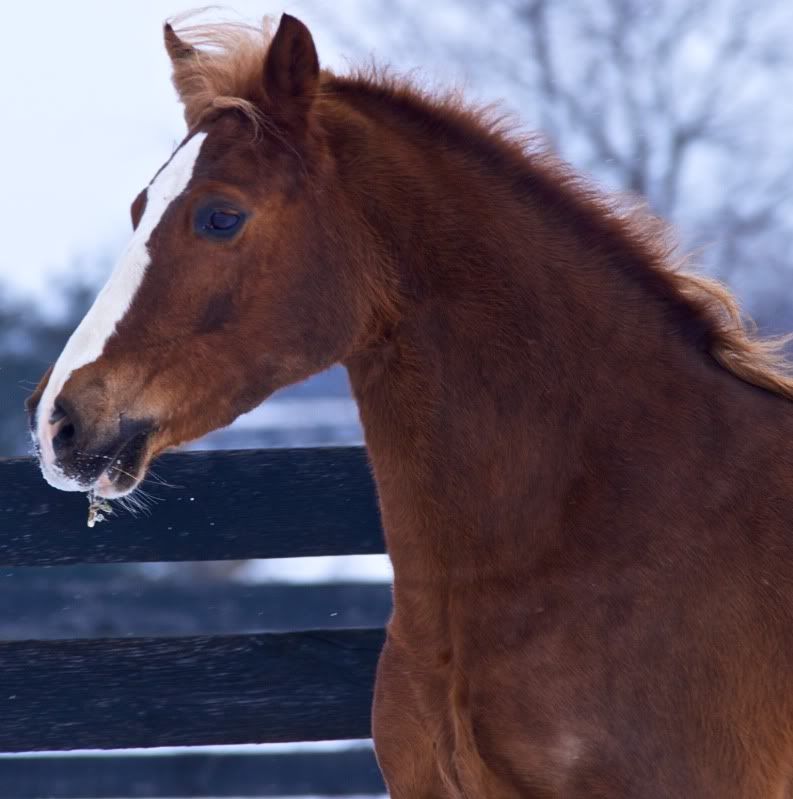
Savant, his sire (now gelded, pictured above) is about 16.2. May was pushing 14.0. So it really makes me wonder where he's going to end up and what he'll look like.
Speaking of classmates, his are huge in comparison. The Lusitano colts tower by at least six inches with attitudes to match. Currently he stands around 12 hands, his growth spurt has slowed down considerably since winter hit.
So with the down time, I found a thread over on COTH about the benchmarks of pony size. Currently he's hitting the range for a large, or just barely horse. But it really makes me wonder, how big is he going to get?
Savant, his sire (now gelded, pictured above) is about 16.2. May was pushing 14.0. So it really makes me wonder where he's going to end up and what he'll look like.
Labels:
dressage,
dressage pony,
May's Diamond Nine,
Sincere G
101 Things: Number 98 stablework
A few years ago, I took up full charge of my horses after years of full care.
It wasn't because I was being cheap. It was because I felt that I could do a better job than the management in my employ.
A number of years later, my ponies are glowing and I feel that my involvement on that level has only made my ponies and myself that much better.
They say success starts at home, and with horses the cliche never rings truer.
That beautiful horse coming down centerline that gleams in the sun and moves like a song isn't an overnight result, it's a product of long-term, consistent, detail-oriented correct management and training.
To produce that kind of result begins on the ground at the barn.
Understandably, most horse owners cannot do the day-in-day-out chores. The lifestyle that they lead suggests they hire someone to do it for them.
But what they can do to understand (and appreciate) is know what is involved in bringing the horse to it's peak potential.
At the very least, owners should know and do the following:
It wasn't because I was being cheap. It was because I felt that I could do a better job than the management in my employ.
A number of years later, my ponies are glowing and I feel that my involvement on that level has only made my ponies and myself that much better.
They say success starts at home, and with horses the cliche never rings truer.
That beautiful horse coming down centerline that gleams in the sun and moves like a song isn't an overnight result, it's a product of long-term, consistent, detail-oriented correct management and training.
To produce that kind of result begins on the ground at the barn.
Understandably, most horse owners cannot do the day-in-day-out chores. The lifestyle that they lead suggests they hire someone to do it for them.
But what they can do to understand (and appreciate) is know what is involved in bringing the horse to it's peak potential.
At the very least, owners should know and do the following:
- Know, and log how frequently you work your horse. What you worked on and where. It doesn't need to be a fancy journal, it can be a calendar, your day planner, or your Blackberry or I Phone. Review periodically.
- Know what your horse is fed. The brands, the supplements, how much, how frequently. Ask about the feed shipments, why did they choose those brands. If your horse isn't doing so hot on that brand, call the company and ask to speak to a nutritionist.
- On the same vein, know how much he drinks as well.
- Know how to muck and properly bed a stall. Nothing is worse going to a show and seeing an under-bedded horse that hasn't slept and is expected to perform. Observe your horse's habits. Does he go in one corner? Or does he grind his manure? Does he walk his stall? Where does he lay down? How?
- Know and keep a schedule of worming, vaccines, massage/chiro work and farrier visits. Make a point to be there, and ask questions of what's going on and how you can improve.
- Keep track of your tack, and keep it in good working order. Know what is working and what isn't.
- Learn how to manage time! The hallmark of a stable is how smoothly and efficiently it runs.
Sunday, January 24, 2010
What you got they can't steal it
Since the weather cleared up briefly, Sincere and I took a walk around the property after his evening supper.
The last time we did this was when he before he was weaned. It lead to much dragging, calling and unhappiness to both parties involved. Since then the weather and time had prevented us from going back out into the wilderness and to be quite frank, I'd rather not go skating behind the young man.
But the other day when we ventured forth he proved beyond brave (minus one puddle that came out of nowhere). In the face of cows, running horses and big scary old tobacco barn he lead willingly past, stood and paid attention, pausing twice to take it all in before venturing on to greater things. Zero screaming, zero pulling, just a lovely walk around the property. He has grown up brave and willing, it should be interesting to see him go under saddle. We concluded with walking over tarps and poles and picking up feet while remaining ground tied.
Speaking of feet, his are excellent. Beautiful wide soles, thick walls and a huge frog. Minus the crack in the right front, which was my fault for not taking care of the chip when I should have, he has no trouble over the tough, rolly terrain that his current field presents. But because of the mud, we're taking note for thrush and other maladies.
Blanketing is still a bit of a challenge. While he happily wears it, getting it on and off can be interesting at times. He should get plenty of practice over the next few weeks, the weather is in flux.
The last time we did this was when he before he was weaned. It lead to much dragging, calling and unhappiness to both parties involved. Since then the weather and time had prevented us from going back out into the wilderness and to be quite frank, I'd rather not go skating behind the young man.
But the other day when we ventured forth he proved beyond brave (minus one puddle that came out of nowhere). In the face of cows, running horses and big scary old tobacco barn he lead willingly past, stood and paid attention, pausing twice to take it all in before venturing on to greater things. Zero screaming, zero pulling, just a lovely walk around the property. He has grown up brave and willing, it should be interesting to see him go under saddle. We concluded with walking over tarps and poles and picking up feet while remaining ground tied.
Speaking of feet, his are excellent. Beautiful wide soles, thick walls and a huge frog. Minus the crack in the right front, which was my fault for not taking care of the chip when I should have, he has no trouble over the tough, rolly terrain that his current field presents. But because of the mud, we're taking note for thrush and other maladies.
Blanketing is still a bit of a challenge. While he happily wears it, getting it on and off can be interesting at times. He should get plenty of practice over the next few weeks, the weather is in flux.
Labels:
dressage,
dressage pony,
Sincere G,
training,
weather
Saturday, January 23, 2010
All together now
$250 later, I have my saddle back with some nice flocking. Again, it's worth every, single, cent.
It also meant that I had to give back the nice Custom Saddlery saddle to my coach. It was a good move too, because I was becoming way too attached. It is for sale for anyone who is interested.
We rode straight through this week, most of it was in the snaffle with one day in the double. Results that were beyond what I expected.
With most of the work concentrated on bending and riding as flexibly as possible, she achieved a better amount of thoroughness and shwung through the back.
The major lateral work was sticky, so I left it be until the end of the week.
By the third session, we were in real work.
We began schooling more transitions, more collection and definitive parts of tests. Such as the double half pass from three-two and the canter V pirouette from PSG.
Schooling in the double was more of a mental exercise on both our ends. Mentally, it was for me to be still and keep the curb light and for her- to not hit the curb and overly react to it.
Schooling piaffe, we utilized the reinback to piaffe. The changes are her forte now, she's crack smart about changing, and threw in a small 'gimme' line of fours on her fresh day in addition to the regular changes. We also schooled reactions, the halt to immediate canter depart, the hi-ho silver routine, which helped immensely in piaffe/passage and medium work.
Pirouette work proved to be more tricky. The first two steps are brilliant, the third to fifth, however present issues. We utilized the 10 meter square exercise to help improve, but we're still about a yard too far from the line.
Shoulder-in and haunches in to the left is still very strong, however to the right, it's still a little hard, especially when I ask for a series of three's (three steps shoulder in, three steps straight, three steps of haunches in). Half pass she's once again getting too straight in the line I have to remember to hold back a few steps then release.
I'm most excited about her collection, Saturday we decided to a bit of back and forth from ultra collected canter immediately to medium/extended. She has it in her, just needs a more emphatic transitions. She gave five excellent transitions late into the session.These will only get better as we school them.
Overall, I'm extremely pleased and Sinari seems quite happy with herself.
On a side note, I'm considering breaking my New Year's vow of no showing. KDA is offering a few classes I feel would be up our alley. I'm also sponsoring said classes with cash incentive.
As much as I would like to complete out my bronze, the length of the counter canter required for second level is now way too much for her. Anyone have a pony that I could go second level on? ;-)
It also meant that I had to give back the nice Custom Saddlery saddle to my coach. It was a good move too, because I was becoming way too attached. It is for sale for anyone who is interested.
We rode straight through this week, most of it was in the snaffle with one day in the double. Results that were beyond what I expected.
With most of the work concentrated on bending and riding as flexibly as possible, she achieved a better amount of thoroughness and shwung through the back.
The major lateral work was sticky, so I left it be until the end of the week.
By the third session, we were in real work.
We began schooling more transitions, more collection and definitive parts of tests. Such as the double half pass from three-two and the canter V pirouette from PSG.
Schooling in the double was more of a mental exercise on both our ends. Mentally, it was for me to be still and keep the curb light and for her- to not hit the curb and overly react to it.
Schooling piaffe, we utilized the reinback to piaffe. The changes are her forte now, she's crack smart about changing, and threw in a small 'gimme' line of fours on her fresh day in addition to the regular changes. We also schooled reactions, the halt to immediate canter depart, the hi-ho silver routine, which helped immensely in piaffe/passage and medium work.
Pirouette work proved to be more tricky. The first two steps are brilliant, the third to fifth, however present issues. We utilized the 10 meter square exercise to help improve, but we're still about a yard too far from the line.
Shoulder-in and haunches in to the left is still very strong, however to the right, it's still a little hard, especially when I ask for a series of three's (three steps shoulder in, three steps straight, three steps of haunches in). Half pass she's once again getting too straight in the line I have to remember to hold back a few steps then release.
I'm most excited about her collection, Saturday we decided to a bit of back and forth from ultra collected canter immediately to medium/extended. She has it in her, just needs a more emphatic transitions. She gave five excellent transitions late into the session.These will only get better as we school them.
Overall, I'm extremely pleased and Sinari seems quite happy with herself.
On a side note, I'm considering breaking my New Year's vow of no showing. KDA is offering a few classes I feel would be up our alley. I'm also sponsoring said classes with cash incentive.
As much as I would like to complete out my bronze, the length of the counter canter required for second level is now way too much for her. Anyone have a pony that I could go second level on? ;-)
Thursday, January 21, 2010
101 Things: Number 99: Fitting saddles
As an owner of a "special" fitting horse, I've become more educated over the years about saddles, bridles and fitting the pony's equipment in general. I've spent countless paycheques to fiddle with various aspects of her equipment and finding equipment that fits and works for the two of us.
It's worth every cent too. A well fitting piece of equipment makes our job that much easier. A bad fitting piece of equipment will make any ride a living hell.
Well fitting saddle is a basic necessity in any sport. However, it seems to be paramount in dressage due to the purposeful, physical development of the equine athlete. The dressage horse changes at every stage of development, to help with that growth, the saddle must change with it.
There are also a plethora of saddles out there, in an infinite amount of seat, tree and flocking combinations to suit tastes and needs.
First the basics: a saddle should be functional.
It should fit the horse and you. It should allow you to keep your position without fighting for it, and allow no restriction in the horse when moving. It should be stable without being static, and should fit the horse while in motion.
Trilogy Saddles has an excellent guide here.
Work with a qualified saddler. Sit in as many saddles as you physically can. Ask your fellow boarders (and your coach!) about theirs, and see if you can't sit and tryout. Take notes on what you felt when you rode in them. Jot the features you liked, and the features you didn't like. Jot what your horse liked and didn't like and how he reacted. If you can have the ride taped.
Educate yourself on flocking. Know the type of wool that is being used, whether it is a long fiber (better quality, doesn't pill), or short fiber (bad, pills and creates pressure points). If there isn't wool, what is inside that saddle? Foam? Air? Aunt Mildred's wig? How does it effect the horse?
Finally, take care of the investment. Clean regularly, condition frequently. Reflock and check the integrity of the tree yearly (more often if you fall off, or the horse has crashed on it).
It's worth every cent too. A well fitting piece of equipment makes our job that much easier. A bad fitting piece of equipment will make any ride a living hell.
Well fitting saddle is a basic necessity in any sport. However, it seems to be paramount in dressage due to the purposeful, physical development of the equine athlete. The dressage horse changes at every stage of development, to help with that growth, the saddle must change with it.
There are also a plethora of saddles out there, in an infinite amount of seat, tree and flocking combinations to suit tastes and needs.
First the basics: a saddle should be functional.
It should fit the horse and you. It should allow you to keep your position without fighting for it, and allow no restriction in the horse when moving. It should be stable without being static, and should fit the horse while in motion.
Trilogy Saddles has an excellent guide here.
Work with a qualified saddler. Sit in as many saddles as you physically can. Ask your fellow boarders (and your coach!) about theirs, and see if you can't sit and tryout. Take notes on what you felt when you rode in them. Jot the features you liked, and the features you didn't like. Jot what your horse liked and didn't like and how he reacted. If you can have the ride taped.
Educate yourself on flocking. Know the type of wool that is being used, whether it is a long fiber (better quality, doesn't pill), or short fiber (bad, pills and creates pressure points). If there isn't wool, what is inside that saddle? Foam? Air? Aunt Mildred's wig? How does it effect the horse?
Finally, take care of the investment. Clean regularly, condition frequently. Reflock and check the integrity of the tree yearly (more often if you fall off, or the horse has crashed on it).
Sunday, January 17, 2010
Here comes the sun
The weather holds a grudge out here. The small window of beautiful, welcoming weather didn't stay.It turned nasty over the weekend.
Rain melted what was left of the snow, and turned everything into slick mud pile.
With the mud Sincere saw fit turn himself in to a plain bay. Slicked down by the driving rain, his fluffy winter coat gave away what he had (or had not) in conformation. So far, he looks pretty good for an awkward youngster. Like the neck, his angles, legs. His croup is a little short, and he's currently even right now, but he does have whithers. Somewhere.
His ears are still big. But I like them.
Despite the nasty, cold weather, the young man in his blanket, ground tied and trimmed well with minor incident.
He led fabulously and is pretty alright with much of what's going on. There is very little worry in him. It's a considerable attitude change from a few months ago. I have a feeling food and attention were much to do with it. But I also think he's coming into his own independent self.
I actually like him and his personality. He's the jock of the group.
While everyone else was at USEF's annual, I was at home filling production. It was well spent. Managed to get a few things done. But still have a lot to do.
Subscribe to:
Posts (Atom)
