Showing posts with label 101 things. Show all posts

Tuesday, June 29, 2010

101 Things: Number 92: The written word

The horse industry is a handshake and nod industry.

Very little formal papered agreements pass through our hands in regards to employment, obligations and rights. The industry norm is usually based on reputation and the good of one's word within the community.

In other words, you expect Jim Bob to show up with the monthly delivery of 100 tons of hay for X dollar amount on Tuesday (he also expects a cheque and a beer). Or you expect that barn builder to throw your fence up at X dollar amount per foot and finish the job at hand.

Because they said they would.

These are unusual practices to to any industry outsider and is confusing considering the amount of cash, capital and product that flows through our hands.

On any given day, a collective, well-bred herd with a performance history is worth minimum, $10,000 and even the cheapest

I remember way back when, even as a working student, that there was no written contractual obligation, just a verbal agreement that I would show up three days a week and clean stalls for a lesson once a week. It wasn't up until recently, that I started putting things in formal writing including keeping track of expenditures and personal labor.

I would like to think that every handshake and nod deal that I've transacted with has gone fabulously, with the goods delivered in full on both parties ends, but all things said, it's also an industry that you've come to expect the unexpected.

Getting things in writing (e.g. creating a contractual obligation) is a necessary thing, it clarifies party responsibilities, creates clear boundaries, and protects individuals from, among other things, faulty memories.

So do yourself a favor, periodically review your boarding contracts, and your transactions. You never know what you might find.

Sunday, May 2, 2010

101 Things: Number 93: Schoolmaster

One of the best things a rider can do for themselves is the gift of education.

Education comes in many forms, books, DVDs, media, forums, instruction, symposium, and a variety of sources but usually, the best is something that has been there, done that and knows the ropes.

Enter the schoolmaster.

These are university professors reincarnated into horse form. They know all the movements, they know how to do them correctly and they know that you don't know any of it.

Usually they are the unassuming 12 plus year old geldings that is a little too worn out of the showing, but still too young for full retirement, who has a low level of tolerance for mistakes and green riders, but won't bury them near the bushes. These equine gems are worth their weight in gold, teaching correct feel, execution and how to ask for specific movements.

The title isn't limited to ex-FEI horses, you can have a schoolmaster who is great from level to level.

The benefit is riders become stronger, more knowledgeable with their aids, gain more confidence through asking for more advance movements and a stronger seat, which translates down the levels to green horses. 

If you have the opportunity especially to ride the upper level masters, do so. You'll thank yourself in the end.

Tuesday, March 30, 2010

101 Things: Number 94: The heart of volunteers

"Service to others is the payment you make for your space here on earth." Muhammad Ali


The man on the left, was known for throwing punches, and not mincing words. While Ali's body may have left him, his service to the nation, particularly my state, is still felt every time he graces us with his presence.
 
Every year with the warmer weather, horse shows and events seemingly spring up everywhere almost overnight. My once empty mailbox is jammed full with show fliers, clinic, and event announcements from around the universe. 

My company, Team EnGaged is also busy putting the roster together for their annual events.


Unlike the weather, these events don't crop up overnight. They are the brainchildren of committees, business owners and several individuals who feel that the community should benefit from their multiple-day soirees.  

But planning only goes far, to have a successful event it takes man power. Lots of it. 

Without volunteers who give up their time, their weekends and sometimes their sanity to support the sport there wouldn't be events to feature our pride and joys at or venues to learn from. 


If you have shown, cliniced or gone anywhere with your horse in tow, you've seen them, and for the most part, relied on them. These weekend warriors endure the elements, packed warm up arenas, multiple schedule sheets and changes and the occasional ill-tempered horse and human to help progress and see the sport continue.

It's time to return the favor. 

For every day of showing, clinicing, symposium, or convention-ing you plan on doing or going to, donate on hour to the sport that is allowing the habit. 

If you don't know where or how to begin, contact your local General Member Organization. Many of which sponsor volunteer training and give several avenues for participation. 

It will not only make you far more appreciative of the regulars standing out in the hot, sandy arena checking bits or behind the desk scribing or scoring, but will open up different avenues of opportunity. 

Also don't forget to say thank you, without them, you don't have a show, or an event to bring your horse to.  

Saturday, March 13, 2010

101 Things: Number 95 Many roads of Rome

I had the pleasure of sitting down to dinner about a week ago with a few USEF official-friends who were in town on business. Collectively sitting at the table was at least 80 years of dressage experience.

These individuals saw the foundation (and actively participated in founding) of the USDF, the L Program, were active FEI riders, still active coaches, and have brought along the best and brightest the industry has to offer. While the conversations ran many directions, it inevitably led to the state of the union of dressage stateside.

The individuals at the table have seen many forms of dressage, good, bad and every shade in between. They have seen abuse, and riding at it's finest. It was a hugely enjoyable experience listening to them.

One of them had the pleasure of seeing the major schools train on a tour of Europe. The Portuguese, Vienna, Samure, Jerez, German, Swedish and Dutch/Netherlands schools, all very different, with different individuals, styles, and different methods to achieve their goals. But all producing the same product: the Grand Prix horse.

Lately, the word 'classical' has become a blanket term in dressage. You frequently hear classically-bred, classically trained, classically-rode, classical-this or that when you frequent forums, conversations or dressage circles. Classical in America, has taken a life of it's own. It's become a selling point without a basic understanding of what it is.

Due to that lack of understanding, many tout one school of thought or method over another, sometimes ad nauseum.

As a dressage rider, disregard the labels.

Any method, wonderful, good, bad or horrible is something you can learn from. Look at it, look at what individuals it is used with, how it is used, digest it and move with it. Learn what and why it works for an individual, take it, and use it. Or don't.

All roads, no matter how long, lead to Rome. There is no main one that is ultimately correct for everyone, but, because the end is just the same, we, as riders must learn to accept and utilize .  It is this understanding that breaks down barriers and creates a richer, more diverse community of riders and teachers and only seeks to better the sport in the long run.

Sunday, February 21, 2010

101 Things: Number 96: Braiding

There is nothing more beautiful than the topline of an upper level horse.

Since, as dressage riders, we spend most of our time developing those and other muscles, it seems natural that we would want to accentuate it in performance.

Braiding is a fundamental grooming technique that shows off a topline. It also shows respect for the sport, the judge and the effort you prepared for the five to seven minutes in the ring.

It's something that everyone should try to pick up along the way. No, you don't need to be artistically inclined or have magic fingers to produce super braids.

You do need to practice.

A lot. Preferably once to twice a week. Of the guides how to do it, the visual learners would like Lucky Braid's guide, the reading group: Grooming to Win and the Pony Club D and C manuals.

The mane types of braids are: button, running, macrame and scalloped.


Buttons are the most traditional. Called for their button size and their four spot center, they are the hallmark of dressage riders. Visually, these are tricky, done well they show a full topline steadily pushing into the bit. Done badly well...

Running or french braid is traditional for breeds that naturally have longer, thicker manes and for owners who don't wish to part with them.

These are becoming more in style lately with the influx of baroque horses. It's an incredibly easy braid to achieve with practice. And while a good running braid can visually add length to the neck, a short chunky one can only detract.

Despite the long nature of the main, it's has to be thin enough to twist and work around, otherwise you will have to either shave half the crest off or do one on each side.

Personally, I prefer the long french braid, which I use every day in schooling (I braid every day). It's thrown together in about five minutes and suits Sinari's neck. Sincere will probably go in buttons (above style).

Macrame also known as the basket weave or the diamond pattern is not frequently seen in the dressage world.

You see it again in long mane breeds whose manes are too thick to do the running braid. It's achieved by pairing sections up and usually ends at the bottom of the neck. The sections are taped in the mane color (black, chestnut, white, ect) 

It's pretty neat to look at, but annoying to ride in.

The scalloped braid is also not as common. It was most popular in the early modern history of the sport, and was used extensively on a few horses in the 80's and 90's.

The braids start out like normal button braids, except instead of doubling under and banding they loop them under each other. It's almost a hybrid of running and button. It produces a neat style for a horse that has a thicker neck, shorter mane but still thick hair type.


Finally, a note about forelocks. Forelocks can be done several ways (a mini french braid or just a braid and ball). Traditionally, they should follow the sex of the horse to whether they should be braided or not. Unbraided forelocks are mature stallions. Braided forelocks are for mares and geldings.

There are different braids for different mane types, lengths and preferences. But for whatever your preference do it well. All good braids have these qualities in common: are tight, they emphasize the outline of the neck, braid sections are evenly proportioned over the space and they never interfere with riding. If you cannot do them well on the day you need to braid, find a braider.

Sunday, February 7, 2010

101 Things: Number 97: The Human Element

On a cold snowy Saturday, I packed my equipment up and headed over to the annual GMO Gala.

The annual speaker this year was the USEF long-listed, Heather Blitz, someone who I've long admired for her ability and personality.

In the hour and a half long speech on her life, her horses, rider bio mechanics and her methods, she mentioned one thing that struck me the most:

"There is not enough concentration by riders on themselves. What feels normal is usually is not correct. What feels correct is interpreted as weird. That the correct place is only "weird" feeling when its new and you make changes to get here, until you do enough repetitions so that it becomes normal feeling. And that it's hard to go for the weird feelings and believing in the beginning that they're right.It's not until we look at ourselves in the mirror we figure out what we've been compensating in."

At that moment, I really felt like standing up and cheering.

As riders, we concentrate so much on the horse's athletic potential that riders forget themselves. Riding is not only a mental game, but a physical one as well. While the average rider doesn't need the physical fitness of top riders or the mental fitness of Einstein, they do need to sit straight, sit in balance and be able to work effectively for at least 30 minutes in the saddle. They need to know theory and practice, be able to mentally condition themselves to the sport and form positive habits that will influence their riding correctly.

We, as humans naturally accept our physical and mental compensations. It's discovering them, accepting them, and then changing them to make the partnership better is vital. Accepting your personal faults is never easy. Changing them is harder.

To become an athletic partner that we intent on being- we need to be aware of what we are doing in and out of the tack, and create a personal system that encourages that correction and development.

(photo credit: Horse Radio Network)

Sunday, January 31, 2010

101 Things: Number 98 stablework

A few years ago, I took up full charge of my horses after years of full care.

It wasn't because I was being cheap. It was because I felt that I could do a better job than the management in my employ.

A number of years later, my ponies are glowing and I feel that my involvement on that level has only made my ponies and myself that much better.

They say success starts at home, and with horses the cliche never rings truer.

That beautiful horse coming down centerline that gleams in the sun and moves like a song isn't an overnight result, it's a product of long-term, consistent, detail-oriented correct management and training.

To produce that kind of result begins on the ground at the barn.

Understandably, most horse owners cannot do the day-in-day-out chores. The lifestyle that they lead suggests they hire someone to do it for them.

But what they can do to understand (and appreciate) is know what is involved in bringing the horse to it's peak potential.

At the very least, owners should know and do the following:

  • Know, and log how frequently you work your horse. What you worked on and where. It doesn't need to be a fancy journal, it can be a calendar, your day planner, or your Blackberry or I Phone. Review periodically.
  • Know what your horse is fed. The brands, the supplements, how much, how frequently. Ask about the feed shipments, why did they choose those brands. If your horse isn't doing so hot on that brand, call the company and ask to speak to a nutritionist. 
  • On the same vein, know how much he drinks as well. 
  • Know how to muck and properly bed a stall. Nothing is worse going to a show and seeing an under-bedded horse that hasn't slept and is expected to perform. Observe your horse's habits. Does he go in one corner? Or does he grind his manure? Does he walk his stall? Where does he lay down? How?
  • Know and keep a schedule of worming, vaccines, massage/chiro work and farrier visits. Make a point to be there, and ask questions of what's going on and how you can improve. 
  • Keep track of your tack, and keep it in good working order. Know what is working and what isn't.
  • Learn how to manage time! The hallmark of a stable is how smoothly and efficiently it runs.

Thursday, January 21, 2010

101 Things: Number 99: Fitting saddles


As an owner of a "special" fitting horse, I've become more educated over the years about saddles, bridles and fitting the pony's equipment in general. I've spent countless paycheques to fiddle with various aspects of her equipment and finding equipment that fits and works for the two of us.

It's worth every cent too. A well fitting piece of equipment makes our job that much easier. A bad fitting piece of equipment will make any ride a living hell. 

Well fitting saddle is a basic necessity in any sport. However, it seems to be paramount in dressage due to the purposeful, physical development of the equine athlete. The dressage horse changes at every stage of development, to help with that growth, the saddle must change with it.


There are also a plethora of saddles out there, in an infinite amount of seat, tree and flocking combinations to suit tastes and needs.

First the basics: a saddle should be functional.

It should fit the horse and you. It should allow you to keep your position without fighting for it, and allow no restriction in the horse when moving. It should be stable without being static, and should fit the horse while in motion.

Trilogy Saddles has an excellent guide here.

Work with a qualified saddler. Sit in as many saddles as you physically can. Ask your fellow boarders (and your coach!) about theirs, and see if you can't sit and tryout. Take notes on what you felt when you rode in them. Jot the features you liked, and the features you didn't like. Jot what your horse liked and didn't like and how he reacted. If you can have the ride taped.

Educate yourself on flocking. Know the type of wool that is being used, whether it is a long fiber (better quality, doesn't pill), or short fiber (bad, pills and creates pressure points). If there isn't wool, what is inside that saddle? Foam? Air? Aunt Mildred's wig? How does it effect the horse?

Finally, take care of the investment. Clean regularly, condition frequently. Reflock and check the integrity of the tree yearly (more often if you fall off, or the horse has crashed on it).

Saturday, January 2, 2010

101 things: Number 100 Anatomy


Let's face it, we ride in a sport that is mostly anatomically involved.

It's a sport about developing the maximum potential of the horse's gaits through correct, consistent training.  While dressage horses are first mentally developed, but along the same lines they are co-developed physically for optimal performance.

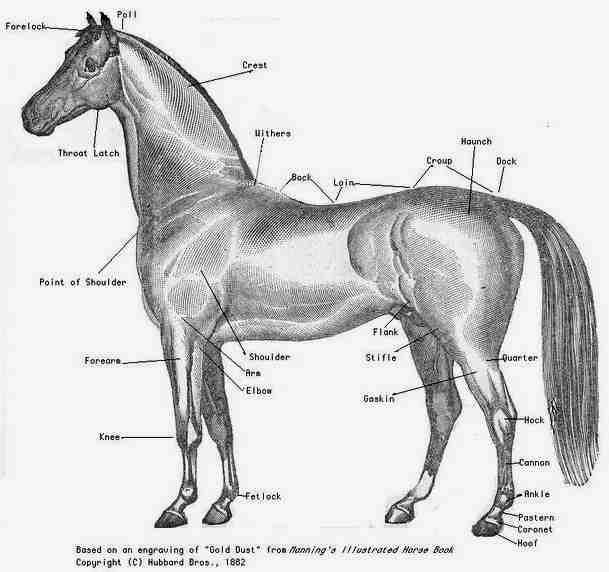
So, it comes as an unfortunate surprise that most people cannot tell the difference between a stifle, gaskin and hock. Or what parts of a gymnastic exercise develop and impact the development of their horse. Or how if the lattimus or longissimus dorsi is preventing the Trapezius muscles from lifting and allowing freedom in the topline.

In the same vein, how or anatomy impacts performance. 

Point is, learning anatomy, equine and human, not only helps you but develop your horse more thoroughly and thoughtfully.

Do you need to run out and memorize Saunder's Anatomy, attend a necropsy or earn a PhD in Bio-Mechanics?

No.

But do learn the basic muscle and skeletal groups you'll be working with consistently and how they all work together to perform the gaits and the movements throughout the levels.

There are several hundred books on the subject, but the classics never go out of style:

Horse Anatomy: A Coloring AtlasThe Equus Illustrated Handbook of Equine Anatomy, Volume 1 and Volume 2
The Anatomy of the Horse
The Dynamic Horse A Biomechanical Guide to Equine Movement and Performance

Tuesday, December 22, 2009

101 things: new series


At work, we have a series of books floating around called 101 things every golfer/diver/audiophile/driver/ect should do before they die. They're beautiful coffee table books.

But it also made me think as a dressage rider. What's 101 things, as a rider I should do before I retire out and go onto bigger pastures?

101st thing: Learn to meter and letter a regulation dressage arena.

A regulation arena is 20 meters by 60 meters (or for those font of feet- 66 by 197- rounded for conversion). This is the only element of dressage the doesn't change with the level. Your dress may change, where you compete and ride may change, your bridle will change, but the 20 by 60 meter box you enter, perform and exit will never change.

The arena is used not only in competition, but in training. Until you've put one together (or ridden in one), the feel of the distance and finite space feels a bit fuzzy. Think walking a jump course versus looking at the diagram.

The arena doesn't need to be show quality, just accurate. You can make an arena out of ten ground poles and a few staked letters. If you need a judges box, an open horse trailer could do as well.

To measure out, start with a corner, stake it and measure 20 meters (66 feet). Mark the second corner. From the second corner measure 60 meters (197 feet) down the length. If your measuring tape is too short, do it in sections, marking off everywhere you left. From the third corner, measure the second short side and then the second long side.

This is the basic outline, to make sure you have a proper rectangle, you measure diagonally from corner one to corner three, and corner four to corner two. Move the corner stakes in or out so that each diagonal line is equal to 207.8 feet. We have rounded the exact measurements in converting meters to feet (20 meters = 65.6 feet and 60 meters = 196.8 feet).

Now you're geometrically correct, lay the letters. The basic package of letters is AKEHCMBE.

Start with A and C, place them half way down the short side, letting A stand back a ways from the entrance. Once aligned start clockwise from C, six meters from the second corner, put M into place, 24 meters B, and six meters from the third corner F. Repeat with K, E and H, same distances. Go back around and align all the letters with each other, using X (center of the arena as a check point.

If you have to move the arena (eventually you will if you groom the arena), mark off letter spaces with electrical tape.

Congratulations, your first arena! Go ride.